What should the reader be able to do?
Write a completion sentence before the title: “After this page, the reader can compare two options using the attached criteria.” This makes the task concrete enough to edit. A topic such as “the future of marketing” can lead anywhere; a decision about which report to send to a client has a recognizable result.
Check whether an existing page already answers the same question. Improve or merge it when appropriate. Create a separate page when the required evidence, audience constraints or next action differ. Maintain a single editorial brief for close variants so overlapping drafts do not become competing partial answers.
What evidence earns a place in the article?
Build a short claim list and attach support before drafting. Use current primary documentation for technical instructions, public research with its scope for empirical claims, and approved original examples for your own work. Distinguish a measured observation from an interpretation and a recommendation from a product capability.
An illustrative guide to comparing support plans could include a completed fictional comparison row showing coverage hours, escalation access and exclusions. The reader should see how the criteria work. A blank list of “quality, value and service” leaves the difficult decision untouched.
How should AI-assisted drafting be reviewed?
Give the draft tool a bounded task, approved evidence and brand language. Then have an accountable editor check each claim, link, example and instruction against the source. A reviewer should be able to explain why the answer is correct and repeat the procedure. Remove unsupported specifics even when they make the prose sound authoritative.
Google's spam policies cover scaled content created primarily to manipulate rankings and third-party content exploiting a host's ranking signals. AI use alone does not determine the policy outcome. Human editing and an AI-detector score provide no exemption; assess the purpose and value of the published work.
What should the page look like?
Lead with the essential answer, then use headings that reflect actual follow-up questions. Place limitations beside the claims they qualify. Keep the example, steps and useful download visible and usable on a phone. Use a relevant next action that continues the reader's task.
Google's AI search guidance does not require a separate special AI version or special schema for its generative Search features. One well-maintained page can serve people and machine access. Any alternate format should have a defined audience purpose and a clear relationship to the main page.
Can an important passage stand on its own?
Try the editorial exercise in Chapter 9 of Become the Answer: read one important passage outside its page context. Can a new reader identify the subject, understand the claim and see its conditions?
Choose the form the reader’s task needs: a definition, an explanation of how something works, factors behind a result, choice criteria, a worked example or a conclusion bounded by evidence. Keep qualifications and support beside the claim. Related answers can share one useful page. These forms guide editing; they carry no measured preference, required word count or promise of AI retrieval.
Who keeps the answer current?
Record the editor, specialist reviewer and facts likely to expire. Tie reviews to product releases, price changes or source revisions where possible. A displayed update date should reflect a meaningful content review or change, not a routine build.
Before release, ask someone unfamiliar with the draft to complete its task. Use their questions to fix missing context. After release, inspect reader engagement and correction requests alongside search and AI observations. A citation is useful evidence of discovery; the reader's ability to finish the task remains the editorial standard.
Answer the reader's question
- Definition
- Question: What is it? Illustrative answer: Route planning software creates a delivery sequence.
- Mechanism
- Question: How does it work? Illustrative answer: It reads orders, groups stops and sends the route to each driver.
- Cause and effect
- Question: Why does it happen? Illustrative answer: Late orders move to the next day because dispatch has closed.
- Criteria
- Question: Which should I choose? Illustrative answer: Choose live routing when orders change during the day.
- Worked example
- Question: How do I do it? Illustrative answer: Upload the orders, set depot hours and review the proposed route.
- Conclusion
- Question: What does the evidence support? Illustrative answer: Static planning fits a fixed schedule.
Adapted from Become the Answer, Chapter 9. This editorial framework uses fictional examples to show ways to answer a reader's question; it does not guarantee AI citation.
Source: Become the Answer, Dmitrij Żatuchin
Download diagram (SVG)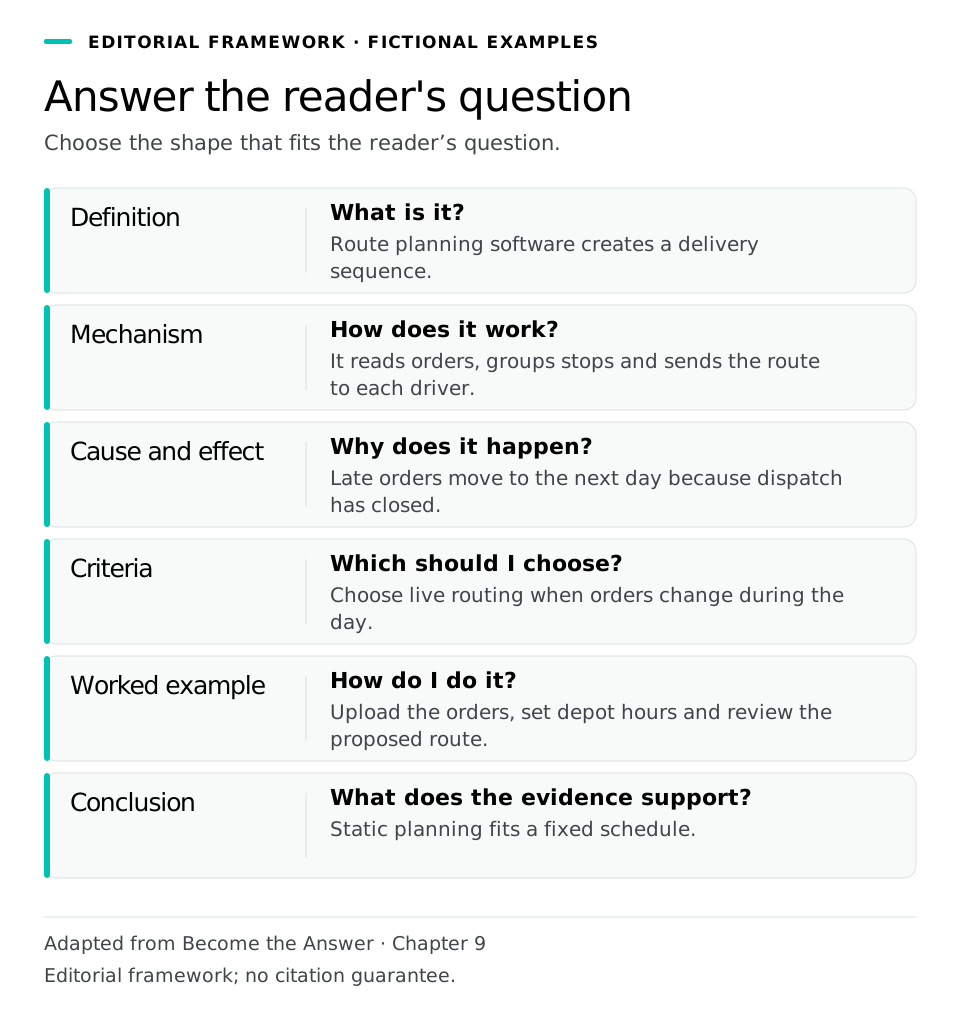
Steps to follow
Define the reader result
Choose a distinct task and check for an existing page serving it.
Prepare the evidence
Attach sources, a worked example and limits to material claims.
Review the finished page
Verify instructions, mobile usability, downloads and a relevant next action.
Assign maintenance
Name the owner and the events that should trigger a factual review.
An evidence-led article review sheet
A blank CSV worksheet for your own evidence and decisions.
Download worksheet (CSV)Sources
Put the guide to work
An evidence-led article review sheet
Explore the public playbooks ↗