What should the baseline measure?
Start with the decision the evidence must support. A product marketer may need to know whether buyers see a correct integration claim. A communications team may care about an outdated company description. Choose the event before opening a dashboard: an unprompted recommendation, a factual error, or a citation to an approved page. Give each event its own column.
A brand can be mentioned accurately without being recommended.
Build a small question set from sales conversations, customer support and procurement documents. Include category discovery, comparisons and factual checks. Keep brand-named questions separate from questions that ask for a shortlist without naming you. Asking an assistant to describe your company tests a different task from asking it to suggest a supplier.
Write down the intended market and language, and state which buyers the question represents.
How do presence and description quality fit together?
The Answer Map in Chapter 2 of Become the Answer places presence in open buyer questions beside description quality from separate brand-named questions. Rarely named but accurately described points toward a discovery investigation. Frequently named but inaccurately described points toward factual repair.
Define “rarely” and “frequently” for the declared sample before plotting. Grade descriptions against verified facts and required detail; record tone separately. A legitimate criticism can be accurate. Leave borderline cases uncertain. The map is a planning framework: each placement belongs to its stated model, language, question set and date.
How do you preserve a usable observation?
Keep a row for every completed answer, with exact prompt, engine, interface, search mode, date and region where supplied. Save the answer text and disclosed citation URLs. Mark failed requests separately so they cannot silently disappear from the denominator. For a manual recommendation measure, define what counts as an affirmative suggestion and count eligible completed answers.
Do not relabel this homemade measure as the Rankfor Index.
For illustration, imagine a fictional scheduling company, Northstar, appears in six of ten answers and is explicitly recommended in four. Your worksheet records six mentions and four recommendations out of ten eligible answers. It also records whether those four recommendations described the product correctly.
These are invented counts showing the calculation, with no implication about Northstar’s real visibility or the precision of a ten-answer sample.
Where does Rankfor fit?
Open the project and select Rankfor Index for the completed engine scan. Read Overview, then Source & Language, and retain the represented dates and languages. The Index combines six components using its own fixed instrument. Treat it as a separate measurement from your custom question worksheet.
A custom question belongs in Answer Trail or a repeated Dice Roller Test; submitting its setup form starts a separate question-specific analysis.
Use the models offered by the current account. Feature pickers can differ, and availability changes. The public playbook library provides workflow context. Record the actual engines and interfaces used, with their coverage limits. Account scan limits also determine when another full scan is available.
What makes the next comparison useful?
Freeze the comparison questions and scoring rules before making changes. Keep exploratory questions in another section so discovering a useful new prompt does not rewrite the old baseline. Repeated observations can reveal variation; the recommendation sampling study shows why observed coverage depends on the sampling horizon.
At review time, compare the same events under the same stated conditions and retain both favorable and unfavorable results. Document website edits, launches and other concurrent activity. Choose an editorial review date, then check product availability for remeasurement. A change in recorded answers is a finding to investigate; proving which action caused it requires a stronger evaluation design.
Keep each platform's observations separate
- Platform A
- Blank record: model, interface and search mode; mention count and eligible-answer denominator; recommendation count and eligible-answer denominator; disclosed citation URLs. Attach the language, market, prompt-set version and collection date.
- Platform B
- Blank record: model, interface and search mode; mention count and eligible-answer denominator; recommendation count and eligible-answer denominator; disclosed citation URLs. Attach the language, market, prompt-set version and collection date.
- Platform C
- Blank record: model, interface and search mode; mention count and eligible-answer denominator; recommendation count and eligible-answer denominator; disclosed citation URLs. Attach the language, market, prompt-set version and collection date.
- Reading the template
- Define an eligible completed answer and each counted event before comparing rows. Keep failed requests and scoring disputes in the underlying ledger. A mention, recommendation and citation are separate observations; these custom counts are not the Rankfor Index.
Adapted from Become the Answer, Chapter 7. This blank editorial template uses generic platform placeholders. Fill it from your saved answer ledger; its custom counts are separate from the Rankfor Index.
Source: Become the Answer, Dmitrij Żatuchin
Download diagram (SVG)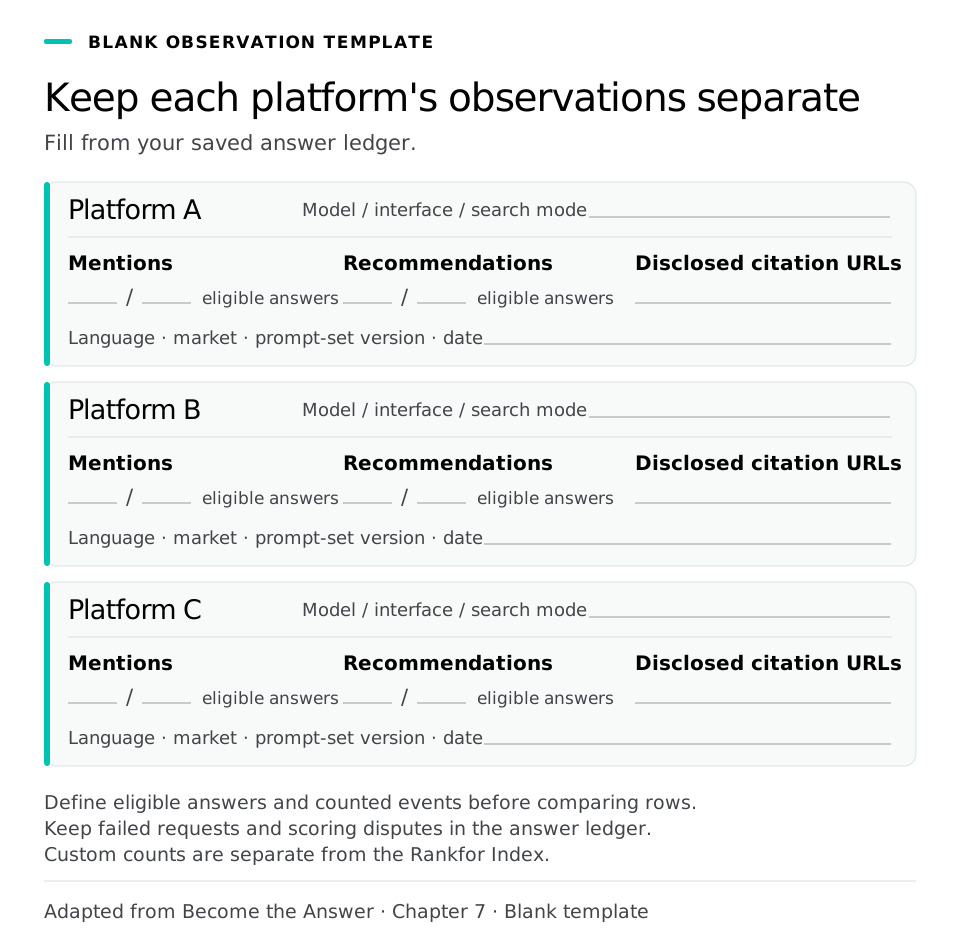
Steps to follow
Define the event
Choose a checkable outcome such as an unprompted recommendation or an incorrect product claim.
Build the baseline
Record exact questions, engine, interface, date, mode and complete answers in the worksheet.
Read the right product record
Use Rankfor Index for its fixed measurement; launch Answer Trail separately for a custom question.
Freeze the comparison
Save scoring rules and questions, then compare equivalent later observations.
AI visibility baseline worksheet
A blank CSV worksheet for your own evidence and decisions.
Download worksheet (CSV)Sources
Put the guide to work
AI visibility baseline worksheet
Explore the public playbooks ↗